|
Lower Crossed Syndrome
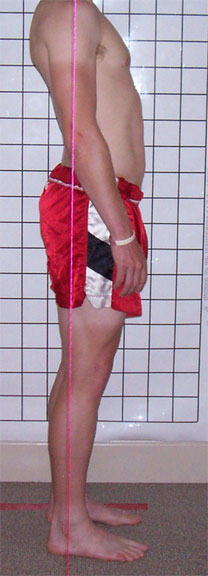
- Lower Crossed Syndrome (LCS) – LCS is simply an imbalance of tissues around the pelvis. Besides the obvious problems of stress being put on both soft and hard tissues, it also affects energy flow back and forth between the upper and lower extremity. Energy cannot flow properly if the pelvis is not set in the correct position, since the pelvis is the transmission of energy for the body.
- One or more of the main hip flexors – rectus femoris, iliopsoas, and tensor fascia latae – are short in LCS.
- The opposite muscles to the short hip flexors, the hip extensors – gluteus maximus, biceps femoris, semi-membranosus and semi-tendonosis – are by default, long and inhibited.
- This configuration of short muscles in the front – and long muscles in the back – of the pelvis, causes the pelvis to move forward and downward.
- Almost always, the hip joint is found to be externally rotated when the pelvis is in this anterior pelvic tilt position.
- In anterior pelvic rotation, coupled with external hip rotation, the gluteus medius and minimus become long and inhibited. This allows the sacrum to drift backwards, causing an increased lumbar lordosis.
- All the above contribute to numerous problems: anterior knee pain, hamstring strain, low back pain from tissue compression, and hyperpronation.
Here is what we have been missing: Lower Crossed Syndrome is a rotational problem. We have very recently discovered the best solution to LCS is visualizing the body in 3-D, and not the way we learned it from our anatomy books. - The Rotex for correction of LCS, and other problems of the lower extremity, lies in rotation.
- Short hip flexors coupled with long hip extensors will cause the pelvis to rotate down and forward.
- Short external hip rotators – piriformis and all its helpers – will cause the gluteus medius and minimus to become long and inhibited. This will cause the hip external rotators of the hip to completely over-power the internal rotators.
- Long and inhibited internal rotators of the hip – gluteus medius and minimus – will:
- Perpetuate the anterior rotation of the pelvis;
- Cause the tensor fascia latae to become short and overactive;
- Cause the already short piriformis to become overactive;
- Cause the short adductors to become short and overactive;
- Cause the same side quadratus lumborum to become short and overactive;
- Cause the opposite side latissimus dorsi to become short and overactive;
- Cause loss of balance and compensation by the nervous system to use large muscles as stabilizers, rather than movers;
- Cause lack of side-to-side stability of the hip joint, affecting balance, coordination, rhythm, agility, speed, strength, and flexibility.
The Rotex helps correct these problems of rotation. When that is done, all these eight listed problems go away – and QUICKLY, because the nervous system no longer must compensate for the weak and long muscles of extension and internal rotation.
|